
Table Of Content
2026 is not just a year of trends with technology. It is the necessity and the very foundation of the business infrastructure. Whether your business stands on just you and a few helping hands, a scaling medium sized setup, or a very large enterprise on international scale. Your system’s security, stability and productivity is a direct result of how well your IT systems are managed? And this is directly linked to the most basic and underlying question: What is the actual cost of Managed IT services and how much are you paying for it?
When we talk about Managed IT services we cannot assume, it would be the same requirements patterns across the whole industry. How? Well, if a small scale business has a less employee count ranging between five to seven people. Then, their only requirements may include remote monitoring along with email support. On the other hand, an enterprise tech firm might require a 24/7 threat detection, audits and backup systems while handling sensitive data.
Here in this article, we will go through industry benchmarks, cost differences based on multiple factors and key services you can expect in relation to the price range. Here, you will not only have a clear idea of how much Managed IT services cost, but also what’s needed and what’s excessive based on your business’s size, risks and growth plans.
Understanding Managed IT Services
With a growing IT company comes the responsibility of maintaining, monitoring and improving its IT infrastructure. The practice of outsourcing such responsibilities to a third party is called Managed IT services. These providers are called Managed Service Provider or MSP. Their services include continuous IT support under an umbrella of a subscription model. This allows companies to invest focus on its core operations. This practice also ensures that the business’s technology stack remains protected, optimized and compliant.
Managed Services vs. In-House IT vs Break/Fix IT
When understanding the true importance of managed IT services, you need to have a clear idea of what’s in comparison to it. This way its helpful and easier to know its worth among other approaches to IT management.
| In-House IT | Break/Fix IT | Managed IT Services |
|---|---|---|
| As the name shows, it involves hiring staff to create a department or team within the official premises. They manage all technology needs of the company internally.
Pros: It offers control and immediate attention. Cons: It is expensive considering the salaries of all hired employees, their benefits, their training costs and buying tool licenses. In case of SMBs, it is very difficult to opt for full-time In-House IT. |
Break/Fix works in a problem arrival-solution needed way. It is a traditional method of paying for a fix when a problem occurs.
Pros: It appears to be cost-effective upfront in some cases. Cons: It’s more reactive than proactive. Your business gets hits from sudden surprise costs, downtime, and unresolved root bugs. These transform into even bigger issues when monitoring tools are not being used. |
Managed IT services have proved to be the most proactive, preventative model so far. Through Managed IT services you can monitor your systems in real time, and work with automated updated.
Pros: They mitigate threats before damage occurs. Their services are also defined according to different contractual levels. This way you can simply pay for ongoing stability without waiting for something to go wrong, and acquire higher expertise. Cons: None reported so far. |
Key Services Provided by Managed IT Providers
Managed IT service packages may differ from business to business as their requirements change. However, all managed IT contracts have some common services, they offer:
Cybersecurity Services: These are all-inclusive, customizable enterprise-grade cyber security services that address the entire security landscape. Firewall management, antivirus deployment, and email filtering are a must part. These also include threat detection and endpoint protection.
Cloud Services Management: It includes keeping track of usage to optimize the cloud’s infrastructure using graphical and user-friendly dashboards.
Backup & Disaster Recovery: It involves the automation of backup scheduling along with offsite data replication. It ensures smooth business flow with recovery planning when a ransomeware attack or data loss are experienced.
IT Help Desk: It provides with ease of exchanging data between an IT help desk software and the business’s CRM. It helps deliver a more responsive IT support service and allows the business to increase its productivity by focusing on the core requirements of the company.
App Modernization: This includes agile and efficient use of intelligent automation along with specialized skills and categorized assets. It focuses on creating new business value using the available applications bringing you to more benefits of cloud hosting.
DevOps and Automation: AIOPS and DevOps with intelligence at the heart of the synthetic IT operations make them one of the most common Managed IT services, clients prefer availing. Predictive analysis, prediction and forecasting along with event management, clustering and thresholding pushes the bar of the system’s efficiency higher.
Remote Monitoring and Management: It includes the continuous track of servers health, the workstations and network infrastructure. It also allows the early detection of hardware failures and security irregularities.
Managed Service Providers vs. IT Consultants: Key Differences
While these two might overlap, their basic functionalities differ from each other:
| MSPs | IT Consultants |
|---|---|
| MSPs focus on providing ongoing operational services. They help manage business infrastructure by offering IT help desk support. They also patch systems and prevent outages. | However, IT consultants have their focus mainly on strategies and approaches used like digital transformation, long term IT planning and software architecture. IT consultants are hired for specific project requirements. They do not offer ongoing support. |
The Advantages of Managed IT Services
With the evolving IT world, businesses face more technical complexity than they did some years ago. With cybersecurity threats on the go and the already added compliance requirements with cloud migrations and progressive expansion of distributed workflow, we need reliable IT support. Though smaller companies do not outsource their IT requirements with some fears or doubts underlying. Like losing control of their IT business workflow or overpaying for the needed services.
Though the reality is different. With managed IT services business often get better results. Managed IT promises low costs over time with improved operational efficiency.
Predictable IT Spending Compared to In-House Teams
One of the biggest point to ponder for business owners is the unpredictability of IT costs. These costs include recruiting staff, training them, retaining internal IT staff, software licensing, security tools and hardware upgrades. In addition to this, salaries of the recruited staff consume a large portion of IT budget.
When businesses opt for managed IT services, they pay a fixed fee per month. This amount covers many expenses under its umbrella i.e. maintenance, support and monitoring. Such a type of pricing model with subscriptions makes budgeting simple and it also eliminates the surprise IT costs.
Managed It services provide following benefits over In house IT:
- The costs are predictable, you will find financial clarity and cost efficiency. MSPs takes your IT business from an unstable fluctuating capital expense and converts it into stable operating expense.
- Your business needs find specialized expertise. MSPs bring in a team of experts trained across domains. Businesses that go for managed IT services benefit higher with a good level of technical proficiency.
- Managed IT providers help your business prevent losses caused by downtime. Such downtime causes money loss either because of ransomware or it could be hardware failure or a natural catastrophe. It could also be because of some disruption that result in loss of revenue. A broken customer trust or compliance violations can also result in such losses. MSPs help your business tackle all of these.
- MSPs also promise your business scalability, productivity and focus on the way.
What Does Managed IT Services Typically Cost?
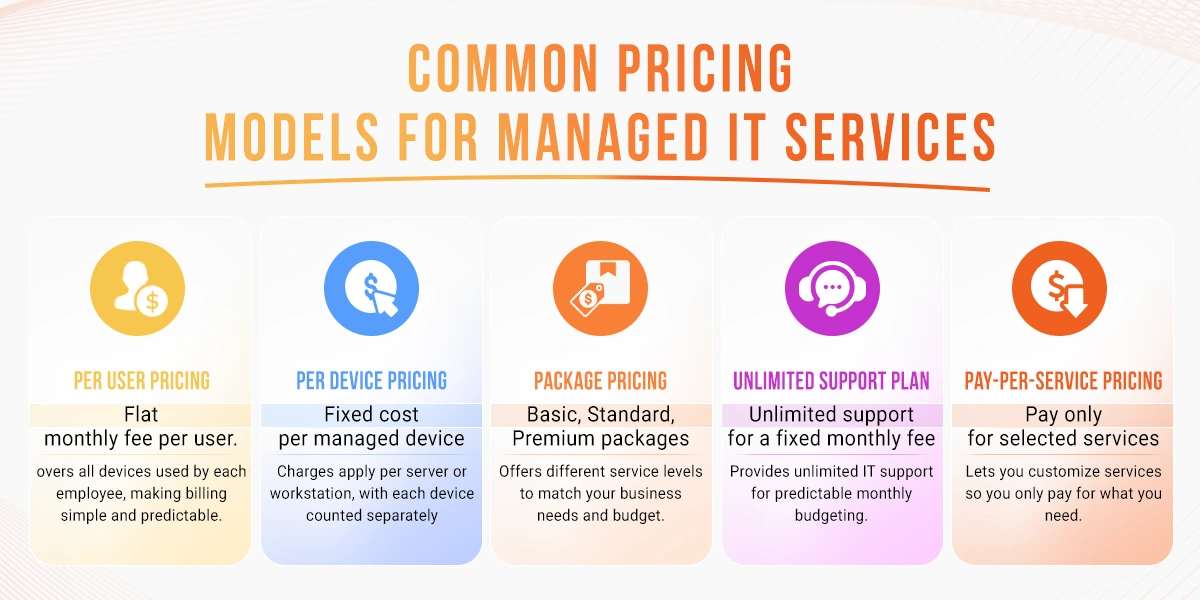
Managed IT services costs vary according to the size and requirement of your business in US and UK. For small businesses (SMBs) ranging around a figure of 50 users might get charged roughly around 75$ to 200$ per user per month.
For medium sized businesses with users increasing up to a figure of 500 will have a different way of pricing. Instead of per person/user, it becomes per device pricing model. Hence, this could roughly charge around 100$ to 250$ per device per month.
For bigger organizations like enterprise level businesses with more than 500 users the pricing becomes a custom monthly contract. This way all the required services are charged after discussion and negotiation between the providers and the business owners.
What Factors Affect the Cost of Managed IT Services?
As we have seen that managed IT services do not have a fixed cost and vary from business to business depending on their requirements. The pricing can vary even if two companies have same number of employees. Because here we are not just dealing with number of users, we see how much work is required and the exposure to risk included. More resources will be used for a complex and mission critical IT environment.
Factors that contribute to the costs of managed IT services are:
- Size and complexity of your IT business environment
- Compliance requirements like HIPAA, GDPR etc.
- Geographical footprint and location of the business, it could be a remote business or an on-site support
- IT help desk hours and service level agreement requirements
- Backup solutions and added tool stacks along with SOC, MDR, and AI monitoring
- Requirement to incorporate customization or standardization into the business
How Your Technology Maturity Impacts Overall Costs
When it comes to the overall costs and pricing, your business IT maturity counts. Organizations that have documented processes and provide with a hub of user management and security policies have a great cut down on costs and are cheaper to support.
In short the cost of managed IT services depends on the tooling and required time invested along with expertise needed for your IT environment demands. The pricing reflects these factors that cover business risk, results expectation and technology complexity.
The Most Common Types of Managed IT Services
The most common types of managed IT services are:
- Remote monitoring and management (RMM)
- IT help desk support
- Cybersecurity services
- Cloud management services
- Backup & disaster recovery
- Unified Communications
- Compliance services
- Endpoint protection
How to Select the Right Managed IT Provider
Selecting the right managed IT provider for your business needs is a decision that greatly impacts your business performance. This also targets its long-term growth and scalability. When it comes to judging whether you made the right decision, always look into what your MSP is providing you with. A good managed IT service provider does more than just resolve your business’s technical issues.
They play role of a strategic partner who understands and supports your IT operations. They proactively counter risks and ensure your systems and operations scale with your IT business.
Conclusion
Choosing the right MSP is all about aligning your business requirements with the needed and right services, level of support with security and scalability. All on a cost that makes senses in the longer run and brings lasting results.
Managed IT is not just about reduction in costs, it also works towards optimizing value. The right managed IT service provider will not only keep your IT systems in shape and running, they will also help them avoid costly downtime. They help the business navigate through evolving security threats. They also support the system for its long term growth. Hence, when you find the right balance between cost and capability, an MSP becomes more than just an IT vendor. They become an important asset of the organization.
Frequently Asked Questions
- What are Managed IT Services?
Managed IT services refer to the outsourcing of IT management and support to a third-party provider known as a Managed Service Provider (MSP). These providers handle tasks such as monitoring systems, cybersecurity, help desk support, and infrastructure management through a subscription-based model.
- How much do Managed IT services typically cost?
The cost varies depending on business size and requirements. Small businesses may pay $75–$200 per user per month, while medium-sized businesses may pay $100–$250 per device per month. Large enterprises usually operate on customized contracts based on their infrastructure and security needs.
- What factors influence the price of Managed IT services?
Several factors affect pricing, including:
- Size and complexity of the IT environment
- Number of users or devices
- Compliance requirements (HIPAA, GDPR, etc.)
- Level of security and monitoring needed
- Help desk availability and service-level agreements (SLAs)
- What services are usually included in Managed IT packages?
Common services include:
- Remote monitoring and management (RMM)
- IT help desk support
- Cybersecurity services
- Cloud infrastructure management
- Backup and disaster recovery
- Endpoint protection and compliance monitoring
- How are Managed IT services different from Break/Fix IT support?
Break/Fix IT support is reactive and only addresses issues when something goes wrong. Managed IT services are proactive, continuously monitoring systems to detect and prevent problems before they impact business operations.
- Are Managed IT services suitable for small businesses?
Yes. Managed IT services are particularly beneficial for small and medium-sized businesses because they provide enterprise-level IT expertise and security without the cost of maintaining a full in-house IT department.
- What is the difference between an MSP and an IT consultant?
An MSP provides ongoing IT management and support, while IT consultants are typically hired for specific projects such as system upgrades, digital transformation strategies, or IT infrastructure planning.
- Can Managed IT services improve cybersecurity?
Yes. Managed IT providers typically offer advanced cybersecurity measures such as threat detection, firewall management, antivirus deployment, endpoint protection, and email filtering to protect businesses from evolving cyber threats.
- How do Managed IT services help reduce downtime?
Through continuous monitoring, automated updates, and proactive maintenance, MSPs detect potential issues early. This prevents system failures, security breaches, and other disruptions that could lead to costly downtime.
- How do businesses choose the right Managed IT service provider?
Businesses should evaluate providers based on:
- Service offerings and expertise
- Security capabilities
- Scalability and flexibility
- Service-level agreements (SLAs)
- Experience with similar industries
References

Senior Solution Architect with 23 years of experience in different Technology sectors. Diligent, forward-thinking, and adaptable to dynamic company, customer, and project needs.
 Managed IT Services Benefits for Businesses in 2026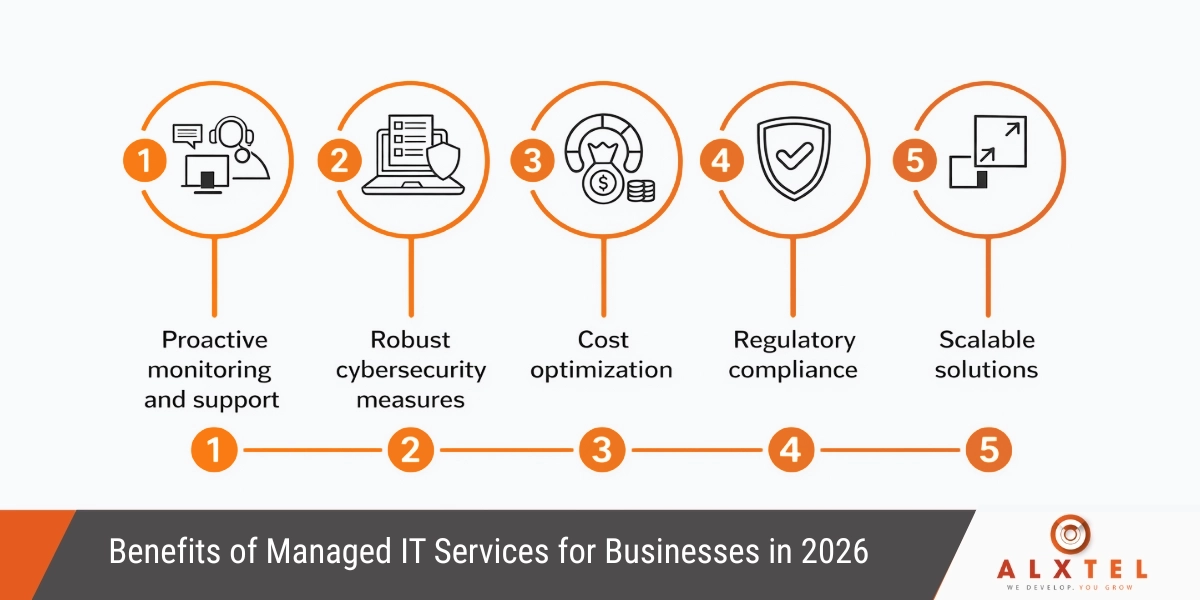


Need support? You are our priority, We’ve got you covered.
Rapid response time to service requests, responding to all customer feedback to get in touch.
Our goal is to supply you with the best possible customer service across all our products and solutions. We look forward to helping you make the most of your AlxTel platform.